
Stakeholder Perceptions of Battery Technologies for Solar Photovoltaic Storage Systems in Lagos, Nigeria

Authors

  • Adeyinka David Adewoyin
    Physics Unit, Distance Learning Institute, University of Lagos, Akoka, Yaba, Lagos, Nigeria.
  • Ibifubara Humphrey
  • Sodiq Abiodun Isikilu
  • Imoleayo Deborah Adewoyin

Keywords:

Battery Energy Storage, Photovoltaic Systems, Battery Technologies, Policy Factor, Economics

Abstract

This study presents a comparative assessment of battery technologies used in solar photovoltaic (PV) energy storage systems, with the objective of identifying the most efficient and context-appropriate solutions for residential and small-scale applications. Data was collected through structured questionnaires administered to 71 respondents using purposive sampling on Lagos Mainland which includes solar engineers, energy practitioners, and end-users in Lagos State. The study employed descriptive and inferential statistics such as Chi-square tests, Analysis of Variance (ANOVA), correlation, and regression analyses using SPSS software. Findings revealed that lead-acid and lithium-ion batteries are the most used technologies. Despite widespread awareness of various battery types (98.6%), statistical analysis showed no significant difference in user-perceived performance across technologies (p > 0.05). Respondents’ perception rated lithium-ion batteries higher in efficiency, lifespan, and environmental friendliness, while lead-acid remained favored for affordability and accessibility. Key barriers to advanced battery adoption included high capital cost and import duties. Furthermore, 70.4% of respondents predicted that lithium-ion batteries will dominate by 2030, with “longer cycle life” identified as the top research priority for future development. The study recommends targeted incentives, local manufacturing support, and sustainable recycling programs to enhance battery adoption and environmental performance in Nigeria’s solar energy sector.
Dimensions

Acharya, S., & Aithal, P. S. (2020). Retaining the Power Backup of the Battery and Increased Life Span of the Battery for the Solar System-Challenges and Opportunities. International Journal of Applied Engineering and Management Letters (IJAEML), 4(2), 265-274. ISSN: 2581-7000. Available at SSRN: https://ssrn.com/abstract=3764248.

Acosta-Banda, A., Aguilar-Esteva, V., Patino Ortiz, M., & Patino Ortiz, J. (2021). Construction and validity of an instrument to evaluate renewable energies and energy sustainability perceptions for social consciousness. Sustainability, 13(4), 2333.

Adam, A. M. (2020). Sample size determination in survey research. Journal of scientific research and reports, 26(5), 90-97. https://doi.org/10.9734/jsrr/2020/v26i530263.

Ahmad, A., Iamarino, M., & D’Angola, A. (2024). A nernst-based approach for modeling of lithium-ion batteries with non-flat voltage characteristics. Energies, 17(16), 3914. doi.org/10.3390/en17163914

Alipour, M., Irannezhad, E., Stewart, R. A., & Sahin, O. (2022). Exploring residential solar PV and battery energy storage adoption motivations and barriers in a mature PV market. Renewable Energy, 190, 684-698. https://doi.org/10.1016/j.renene.2022.03.040.

Almadhhachi, M., Alshibil, A. M., Ali, M., & Machi, M. H. (2025). Batteries in PV systems: A comprehensive analysis of performance, efficiency, and cost in personal house use. International Journal of Science and Research Archive, 15(3). doi.org/10.30574/ijsra.2025.15.3.1797.

Pilamunga, B. O. C., López, M. B. C., Monar, K. R. G., & Sarango, A. F. H. (2024). Chi Cuadrado y tablas de contingencia aplicado en SPSS. Código Científico Revista de Investigación, 5(E3), 499-513. https://doi.org/10.55813/gaea/ccri/v5/nE3/329.

Chen, J., Wang, Y., Guo, D., Liu, Z., Wang, Y., Li, S., ... & Zheng, Y. (2025). Advancing battery research through Large Language Models: A review. The Innovation.

Costa, C. M., Merazzo, K. J., Gonçalves, R., Amos, C., & Lanceros-Méndez, S. (2021). Magnetically active lithium-ion batteries towards battery performance improvement. Iscience, 24(6).

Dwipayana, I. P. G. I., Kumara, I. N. S., & Setiawan, I. N. (2021). Status of Battery in Indonesia to Support Application of Solar PV with Energy Storage. Journal of Electrical, Electronics and Informatics, 5(1), 29-40.

Elazab, R., & Daowd, M. (2025). A novel holistic metric for sustainability assessment of photovoltaic/battery systems. Scientific Reports, 15(1), 30018. https://doi.org/10.1038/s41598-025-14809-z.

Ergun, S., Dik, A., Boukhanouf, R., & Omer, S. (2025). Large-scale renewable energy integration: tackling technical obstacles and exploring energy storage innovations. Sustainability, 17(3), 1311. doi.org/10.3390/su17031311

Farhan, M., Naeem, R., Shoaib, H. M., Irshad, A., Ismail, M., Rabia, R., ... & Munir, F. (2025). Comprehensive review of emerging lithium and sodium-ion electrochemical systems for advanced energy storage applications. Sch. J. Phys. Math. Stat, 12(05), 188-198. https://doi.org/10.36347/sjpms.2025.v12i05.005.

Fett, D., Dehler-Holland, J., & Schmutz, M. (2021, June). A survey on the user acceptance of PV battery storage systems. In Sustainability Management Forum| NachhaltigkeitsManagementForum (Vol. 29, No. 2, pp. 161-171). Berlin/Heidelberg: Springer Berlin Heidelberg. https://doi.org/doi.org/10.1007/s00550-021-00513-9.

George, R. O., Ugwu, S. N., Nwulu, N., & Ezema, F. I. (2023). Characterization and energy storage performance assessment of repurposed 18650 cylindrical lithium-ion cells for second life application in battery energy storage systems. MRS Advances, 8(15), 860-870. https://doi.org//10.1557/s43580-023-00661-8.

Hassini, M., Mintsa-Eya, C., Redondo-Iglesias, E., & Venet, P. (2025, October). Influence of Cell Position on the Capacity of Retired Batteries: Experimental and Statistical Studies. In IECON 2025–51st Annual Conference of the IEEE Industrial Electronics Society (pp. 1-5). IEEE.

https://doi.org//10.1109/IECON58223.2025.11221867.

Huang, H. L., & Cheng, L. K. (2023). Predicting intention of residential solar installation: The role of ecological lifestyle, consumer innovativeness, perceived benefit, government incentives, and solar product knowledge. Energy & Environment, 34(6), 1826-1843. https://doi.org/10.1177/0958305X221100525.

Humphrey, I. (2024). PV-Wind Hybrid Electricity Supply System for Remote Communities in Rivers State: A Techno-Economic Approach. Uniport Journal of Engineering and Scientific Research (UJESR). Vol. 8, Issue 2, 2024, Page 346-363 ISSN: 2616-1192.

Isa, M. F., Bayel, H. S., Bello, M., & Aidan, J. (2026). Design and Sizing of an Off-Grid Solar Photovoltaic (PV) System for an Office Unit at Modibbo Adama University, Yola-Nigeria. Nigerian Journal of Physics, 35(4), 91-100. https://doi.org/10.62292/njp.v35i4.2026.630

Kalkbrenner, M. T. (2021). A Practical Guide to Instrument Development and Score Validation in the Social Sciences: The MEASURE Approach. Practical Assessment, Research & Evaluation, 26, 1.

Kilanowski, J. F. (2018). Using Google to survey PNPs about agricultural safety. Journal of Pediatric Health Care, 32(5), 481-484. https://doi.org/10.1016/j.pedhc.2018.04.004.

Kurniawan, N., & Nadlifatin, R. (2024, September). Factors Affecting Willingness to Use Solar Photovoltaic Technology: A Systematic Literature Review. In 2024 IEEE Technology & Engineering Management Conference-Asia Pacific (TEMSCON-ASPAC) (pp. 1-8). IEEE. https://doi.org/10.1109/TEMSCON-ASPAC62480.2024.11024592.

Lei, T., Ji, J., Du, G., Shen, H., Zhao, X., & Chen, X. (2025, March). Analysis and Protection Research on Switching Overvoltage Characteristics in GWh-Level Cascaded High-Voltage Battery Energy Storage Systems. In 2025 7th Asia Energy and Electrical Engineering Symposium (AEEES) (pp. 863-869). https://doi/org//10.1109/AEEES64634.2025.11019671.

Maka, A. O., & Chaudhary, T. N. (2024). Performance investigation of solar photovoltaic systems integrated with battery energy storage. Journal of Energy Storage, 84, 110784. https://doi.org/10.1016/j.est.2024.110784

Mossa, M. A., El Ouanjli, N., Ouaissa, M., Ouaissa, M., & Dhanaraj, R. K. (2025). Energy Conversion Systems-Based Artificial Intelligence.

Orizu, G. E., Okpala, U. V., & Humphrey, I. (2019). Determination of Number of Days of Autonomy for Battery Sizing in Lagos, Nigeria. IFE Journal of Science and Technology, 3(1), 133-141.

Rahman, M. M., Islam, M. M., Shafiullah, M., Islam, M. A., Chowdhury, M. A. R., & Zahir, M. H. (2025). Advancing grid integration with redox flow batteries: an engineering and economic review. Green Chemistry Letters and Reviews, 18(1), 2507333. https://doi.org/10.1080/17518253.2025.2507333.

Raj, P., Richter, E., Herb, F., Kempf, J., Michel, F., & Birke, K. P. (2024). Electrochemical and aging model of li-ion batteries and estimation of total number of cycles during the lifecycle of the battery. E-Prime-Advances in Electrical Engineering, Electronics and Energy, 9, 100712.https://doi.org/10.1016/j.prime.2024.100712

Rodby, K. E. (2022). Battery deployment in the US faces non-technical barriers. MIT Science Policy Review, 3. https://doi.org/10.38105/spr.lc6a23w5va.

SAAD, A. M. H. (2025). Integrating Battery Systems with Solar Inverters to Enhance Solar Energy Utilization and Grid Stability for a Sustainable Future: A Review. Journal of Digital Food, Energy & Water Systems, 6(1). https://doi.org/10.36615/8j9sfc20.

Shakeel, S. R., Yousaf, H., Irfan, M., & Rajala, A. (2023). Solar PV adoption at household level: Insights based on a systematic literature review. Energy Strategy Reviews, 50, 101178. https://doi.org/10.1016/j.esr.2023.101178.

Shaktivel, R., Yao, S. C., Heng, J. B., Teo, T. H., & Kok, C. L. (2025, November). Harnessing Grid-Scale Energy Storage for Renewable Energy Integration: Case Studies of Flow Batteries and Compressed Air Energy Storage. In 2025 IEEE International Conference on Recent Advances in Systems Science and Engineering (RASSE) (pp. 1-6). IEEE. https://doi.org/10.1109/RASSE64831.2025.11315306.

Sridevi, J., Ananthi, S., Gokilavani, R., Al-Farouni, M., & Ameer, S. A. (2024). Life Cycle Assessment of Battery Energy Storage Technologies for Vehicular Applications. In E3S Web of Conferences (Vol. 564, p. 08004). EDP Sciences. https://doi.org/10.1051/e3sconf/202456408004.

Wang, Y., Hong, H., Wei, Z., Yang, X., Li, D., Wang, S., & Zhi, C. (2025). Pathways to Realize High‐Energy Density Aqueous Redox Flow Batteries. Advanced Functional Materials, 35(48), 2507320. https://doi.org/10.1002/adfm.202507320.

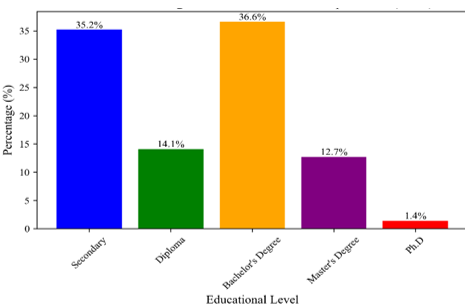
Educational Background of Respondents (n = 71)

Published

2026-11-02

How to Cite

Adewoyin, A. D., Humphrey, I., Isikilu, S. A., & Adewoyin, I. D. (2026). Stakeholder Perceptions of Battery Technologies for Solar Photovoltaic Storage Systems in Lagos, Nigeria. Nigerian Journal of Physics, 35(S), 532-542. https://doi.org/10.62292/njp.v35(s).2026.773

How to Cite

Adewoyin, A. D., Humphrey, I., Isikilu, S. A., & Adewoyin, I. D. (2026). Stakeholder Perceptions of Battery Technologies for Solar Photovoltaic Storage Systems in Lagos, Nigeria. Nigerian Journal of Physics, 35(S), 532-542. https://doi.org/10.62292/njp.v35(s).2026.773

Most read articles by the same author(s)