
Comparative Study of the Performance of Black-Coated and Reflecting-Surface Solar Box Cookers and a Parabolic Dish Solar Cooker

Authors

  • Nathaniel Muwa Shawhatsu
    Department of Science Laboratory Technology, Federal Polytechnic Bali, Taraba State, Nigeria.
  • Joseph Aidan
  • Abubakar Alkasim

Keywords:

Solar box cooker, Parabolic dish cooker, Figures of merit, Energy and exergy efficiency, Cooking power, Heat retention

Abstract

The thermal performance of a two-compartment solar box cooker and a parabolic dish solar cooker were experimented and compared under same environmental conditions at [name of laboratory/workshop], Bali Town, Taraba State, Nigeria. The identical box compartments (aperture 0.334 m² each) shared one glazing and two booster mirrors; one had black-coated inner surfaces (SC.B) and the other reflecting walls with a black floor (SC.RB). The dish (P.SC) had an aperture of 0.950 m². Stagnation, four-day water-boiling (1 kg of water per pot), heating-and-cooling and single-day rice-cooking tests were carried out. The measured four-day mean maximum water temperatures were 95.1 °C (SC.B), 95.0 °C (SC.RB) and 81.0 °C (P.SC), and the cooling time constants were 182–270 min for the box pots against 50–60 min for the dish pot. Both compartments cooked 1 kg of parboiled rice (maxima 98.3 °C and 97.5 °C), whereas the dish reached only 78.6 °C. The derived first figure of merit was 0.117 (SC.B) and 0.119 (SC.RB) K m² W−1, at the grade A/B boundary. SC.RB heated faster during the first 100 min, but the daily maximum temperatures, useful energies and efficiencies of the compartments did not differ significantly. Referred to the glazed aperture and global irradiance, each compartment was 2.3 times as efficient as the dish (9.7% against 4.2%); allowing for the booster-mirror radiation and for the beam-only acceptance of the dish reduces this ratio to about 1.2. These findings apply only to the prototypes, loads and weather conditions tested.
Dimensions

Abdulrahim, A. T., Abdulkareem, S., Haruna, M., Maina, M. B., & Abdulraheem, S. A. (2021). Assessment of solar box cooker (SBC) with kapok fiber insulator under Maiduguri weather conditions. Arid Zone Journal of Engineering, Technology and Environment, 17(2), 211–220. https://www.azojete.com.ng/index.php/azojete/article/view/423

Abutu, J., Kojeng, F., Ahmadu, A. A., Salawu, S. I., & Medupin, R. O. (2022). Performance evaluation of a trapezoidal box-type solar cooker fabricated using locally-sourced materials in Jalingo. Taraba Journal of Engineering and Technology, 2(2), 66–73. [DOI or URL]

Ademe, Z., & Hameer, S. (2018). Design, construction and performance evaluation of a box type solar cooker with a glazing wiper mechanism. AIMS Energy, 6(1), 146–169. https://doi.org/10.3934/energy.2018.1.146

Aramesh, M., Ghalebani, M., Kasaeian, A., Zamani, H., Lorenzini, G., Mahian, O., & Wongwises, S. (2019). A review of recent advances in solar cooking technology. Renewable Energy, 140, 419–435. https://doi.org/10.1016/j.renene.2019.03.021

Aririguzo, J. C. (2024). Design and performance evaluation of a parabolic solar cooker for rural communities in Eastern Nigeria. Nigeria Agricultural Journal, 54(2), 214–222.

ASAE. (2013). ASAE S580.1 NOV2013: Testing and reporting solar cooker performance. American Society of Agricultural and Biological Engineers. https://standards.globalspec.com/std/14603399/s580-1

Bayabl, A. M., & Balasuadhakar, A. (2019). Experimental comparison analysis of white coated and black coated inside box type solar cooker. International Journal of Advances in Scientific Research and Engineering, 5(5), 260–265. https://doi.org/10.31695/IJASRE.2019.33226

Bigelow, A. W., Tabatchnick, J., & Hughes, C. (2024). Testing solar cookers for cooking efficiency. Solar Energy Advances, 4, Article 100053. https://doi.org/10.1016/j.seja.2024.100053

BIS. (2000). IS 13429 (Part 3): 2000 Solar cooker – box type – specification. Part 3: Test methods (1st rev.). Bureau of Indian Standards. https://law.resource.org/pub/in/bis/S08/is.13429.3.2000.pdf

Das, L., Solomon, S. S., & Saini, A. (2019). Thermal analysis of paraboloid dish type solar cooker. Journal of Physics: Conference Series, 1276, Article 012055. https://doi.org/10.1088/1742-6596/1276/1/012055

Elijah, M. I., & Lamidi, B. T. (2023). Parasite infestation of cockroaches in Bali Town, Taraba State, Nigeria. International Journal of Current Researches in Sciences, Social Sciences and Languages, 4(1)

Erbs, D. G., Klein, S. A., & Duffie, J. A. (1982). Estimation of the diffuse radiation fraction for hourly, daily and monthly-average global radiation. Solar Energy, 28(4), 293–302. https://doi.org/10.1016/0038-092X(82)90302-4

Funk, P. A. (2000). Evaluating the international standard procedure for testing solar cookers and reporting performance. Solar Energy, 68(1), 1–7. https://doi.org/10.1016/S0038-092X(99)00059-6

Iganga, E. M., & Lamidi, T. (2023, December). A preliminary survey on the fish fauna of River Taraba at Bali Town, Taraba State, Nigeria [Conference paper]. [conference name; DOI or URL]

Kundapur, A., & Sudhir, C. V. (2009). Proposal for new world standard for testing solar cookers. Journal of Engineering Science and Technology, 4(3), 272–281. https://jestec.taylors.edu.my/Vol%204%20Issue%203%20September%2009/Vol_4_3_272-281_Ashok%20Kundapur.pdf

Ladan, H. M. A., Buba, A. D. A., & Adelabu, J. S. A. (2024). Temperature based models for determining solar radiation in the savannah region. Nigerian Journal of Physics, 33(4), 10–20. https://doi.org/10.62292/njp.v33i4.2024.317

Lentswe, K. A., Mawire, A., Owusu, P., & Shobo, A. B. (2021). A review of parabolic solar cookers with thermal energy storage. Heliyon, 7(10), Article e08226. https://doi.org/10.1016/j.heliyon.2021.e08226

Mahavar, S., Sengar, N., & Dashora, P. (2013). Modelling and on-field testing of a solar rice cooker. Energy, 49, 404–412. [DOI]

Mekonnen, B. A., Liyew, K. W., & Tigabu, M. T. (2020). Solar cooking in Ethiopia: Experimental testing and performance evaluation of SK14 solar cooker. Case Studies in Thermal Engineering, 22, Article 100766. https://doi.org/10.1016/j.csite.2020.100766

Mullick, S. C., Kandpal, T. C., & Kumar, S. (1991). Thermal test procedure for a paraboloid concentrator solar cooker. Solar Energy, 46(3), 139–144. https://doi.org/10.1016/0038-092X(91)90087-D

Mullick, S. C., Kandpal, T. C., & Kumar, S. (1996). Testing of box-type solar cooker: Second figure of merit F2 and its variation with load and number of pots. Solar Energy, 57(5), 409–413. https://doi.org/10.1016/S0038-092X(96)00116-8

Mullick, S. C., Kandpal, T. C., & Saxena, A. K. (1987). Thermal test procedure for box-type solar cookers. Solar Energy, 39(4), 353–360. https://doi.org/10.1016/S0038-092X(87)80021-X

NASA Langley Research Center. (2026). NASA Prediction Of Worldwide Energy Resources (POWER) project: Climatology data for 7.86° N, 10.96° E [Data set]. https://power.larc.nasa.gov/

Petela, R. (2003). Exergy of undiluted thermal radiation. Solar Energy, 74(6), 469–488. https://doi.org/10.1016/S0038-092X(03)00226-3

Saxena, A., Norton, B., Goel, V., & Singh, D. B. (2022). Solar cooking innovations, their appropriateness, and viability. Environmental Science and Pollution Research, 29, 58537–58560. https://doi.org/10.1007/s11356-022-21670-4

Shaw, S. (2002). Development of a comparative framework for evaluating the performance of solar cooking devices [Thesis, Rensselaer Polytechnic Institute]. [URL]

Theu, A. P., & Kimambo, C. Z. M. (2023). Performance analysis of parabolic dish solar cooking system with improved receiver designs. Renewable Energy and Environmental Sustainability, 8, Article 1. https://doi.org/10.1051/rees/2022015

Wassie, H. M., Getie, M. Z., Alem, M. S., Kotu, T. B., & Salehdress, Z. M. (2022). Experimental investigation of the effect of reflectors on thermal performance of box type solar cooker. Heliyon, 8(12), Article e12324. https://doi.org/10.1016/j.heliyon.2022.e12324

WHO. (2025, December 16). Household air pollution [Fact sheet]. World Health Organization. https://www.who.int/news-room/fact-sheets/detail/household-air-pollution-and-health

Yetano Roche, M., Slater, J., Malley, C., Sesan, T., & Eleri, E. O. (2024). Towards clean cooking energy for all in Nigeria: Pathways and impacts. Energy Strategy Reviews, 53, Article 101366. https://doi.org/10.1016/j.esr.2024.101366

Zwiers, F. W., & von Storch, H. (1995). Taking serial correlation into account in tests of the mean. Journal of Climate, 8(2), 336–351. https://doi.org/10.1175/1520-0442 (1995)008<0336:TSCIAI>2.0.CO;2

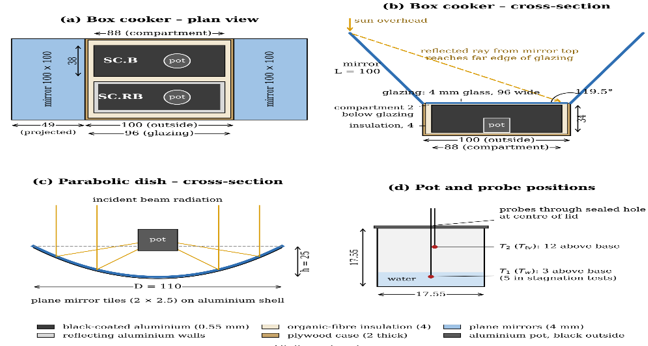
Schematic of the Cookers Tested, with Dimensions in cm: (a) Plan View of the Two-compartment box Cooker (SC.B and SC.RB) Showing the Two Booster Mirrors; (b) Cross-section of the Box Cooker Normal to the Mirror Edges, with the Mirrors at 119.5° to the Glazing and the Reflected Ray that Defines this Angle; (c) Cross-section of the Parabolic Dish Cooker (D = 110 cm, h = 25 cm) with the Pot at the Focus; (d) pot with the Positions of the Thermocouple Probes

Published

2026-10-28

How to Cite

Shawhatsu, N. M., Aidan, J., & Alkasim, A. (2026). Comparative Study of the Performance of Black-Coated and Reflecting-Surface Solar Box Cookers and a Parabolic Dish Solar Cooker. Nigerian Journal of Physics, 35(S), 460-477. https://doi.org/10.62292/njp.v35(s).2026.768

How to Cite

Shawhatsu, N. M., Aidan, J., & Alkasim, A. (2026). Comparative Study of the Performance of Black-Coated and Reflecting-Surface Solar Box Cookers and a Parabolic Dish Solar Cooker. Nigerian Journal of Physics, 35(S), 460-477. https://doi.org/10.62292/njp.v35(s).2026.768

Most read articles by the same author(s)