
Quantum Biophysical Framework for Modeling Neural Dynamics: Entanglement, Decoherence, Synchronization, and Their Role in Emergent Cognition and Brain Function
Keywords:
Neural network, Quantum coherence, Superposition, Entanglement, Lindblad decoherenceAbstract
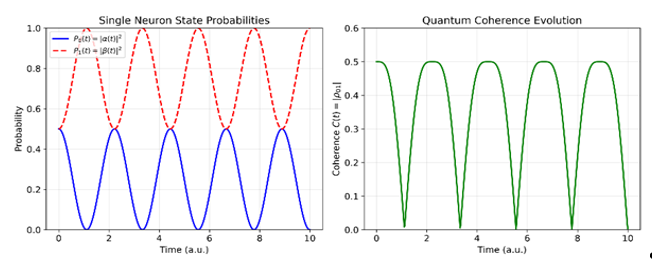
Understanding how cognition emerges from collective neural activity remains a fundamental challenge in neuroscience. While conventional models rely on classical neural interactions, quantum theory suggests biological information processing may also involve quantum phenomena. This study develops a quantum biophysical framework to model neural dynamics and explore the quantum emergence of cognition. Beginning with a single-neuron model characterized by quantum superposition and coherence, the framework scales to interacting neural populations using quantum entanglement and a neural-network Hamiltonian. We incorporate environmental decoherence via the Lindblad master equation, while modeling large-scale coordination through Kuramoto synchronization dynamics. To quantify these dynamics, a candidate Emergent Cognition Index (ECI) was computationally formulated and evaluated, integrating superposition, coherence, entanglement, and synchronization. Numerical simulations of 100 interacting neurons demonstrated that environmental decoherence reduces superposition and coherence over time, whereas entanglement and synchronization increase with stronger neural interactions. Analysis of the neural-network Hamiltonian showed progressing collective organization through elevated interaction energy. Phase-transition modeling revealed a continuous shift from a quantum-coherent state to a classical neural state under increasing decoherence. Within the simulation, the candidate cognition index peaked near the critical regime where quantum coherence, entanglement, and synchronization coexist. These findings suggest cognition can be interpreted as an emergent phenomenon arising from the interplay among quantum coherence, entanglement, neural interactions, synchronization, and decoherence. While the proposed index serves as a theoretical construct, the framework provides testable predictions and a foundational bridge between physics and neuroscience for future experimental validation
Published
How to Cite
Issue
Section
Copyright (c) 2026 Uchechi Patricia Okpechi-Kanayochukwu, Elizabeth Chinyere Nwaokorogwu, Joseph Ugochukwu, Uchechi A. Uzo-Njoku

This work is licensed under a Creative Commons Attribution-NonCommercial 4.0 International License.