
Development and Experimental Evaluation of a Modified Computational Model for Estimating Occupational Whole-Body Radiation Dose in the Conventional Diagnostic Radiography Unit of Federal Medical Center, Jalingo, Taraba State, Nigeria
Keywords:
Computational dosimetry, Occupational radiation dose, Diagnostic radiography, Thermoluminescent dosimetry, Monte Carlo simulation, Bland–Altman analysis, Sensitivity analysisAbstract
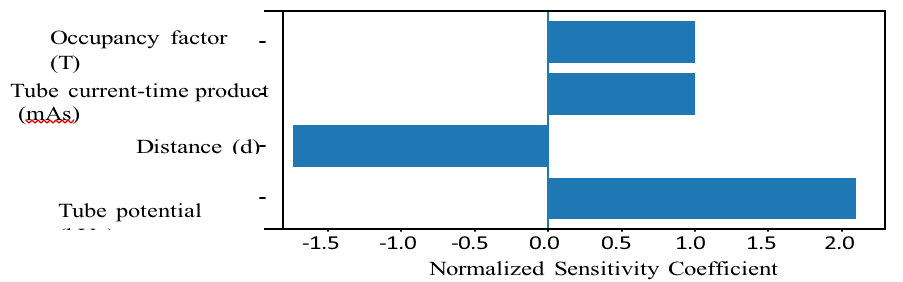
Personal dosimetry using thermoluminescent dosimeters (TLDs) can be constrained in resource-limited settings by equipment, processing, and logistical requirements, motivating the development of complementary computational approaches for occupational radiation-dose estimation. This study developed and experimentally evaluated a calibrated computational model for estimating personnel whole-body radiation dose in a conventional diagnostic radiography unit. The primary model incorporated tube potential (kVp), tube current–time product (mAs), source-to-personnel distance, occupancy factor, and a facility-specific calibration coefficient. We obtained six-month personnel dose measurements using chest-worn TLD badges from 15 radiography personnel at the Federal Medical Centre, Jalingo, Nigeria, and compared them with Monte Carlo estimates based on 10,000 simulations per participant. The TLD-measured doses ranged from 0.96 to 1.78 mSv, with a mean of 1.479 ± 0.216 mSv, whereas the corresponding Monte Carlo estimates ranged from 2.204 to 2.265 mSv, with a mean of 2.234 ± 0.017 mSv. The mean model–measurement difference was 0.755 mSv, indicating systematic overestimation by the computational model. Bland–Altman analysis gave 95% limits of agreement of 0.311 to 1.199 mSv, with 14 of 15 observations (93.3%) falling within these limits. One-at-a-time sensitivity analysis demonstrated that source-to-personnel distance and tube potential had the strongest analytical influence on model output because of their squared dependence in the dose equation, while mAs and occupancy factor exhibited first-order dependence. The findings indicate that the calibrated model reproduced the general magnitude of personnel whole-body dose but systematically overestimated the measured TLD values. The model may therefore be useful as a complementary screening and dose-estimation approach, but further calibration and independent validation using larger datasets and multiple radiography facilities are required before application to individual dose assessment
Published
How to Cite
Issue
Section
Copyright (c) 2026 Abubakar Musa, Osita C. Meludu, Pascal Timtere

This work is licensed under a Creative Commons Attribution-NonCommercial 4.0 International License.
How to Cite
Most read articles by the same author(s)
- Livinus Linus Dangari, Pascal Timtere, Ishaya Istifanus Fwangle, Assessment of Natural Radioactivity in Spring, Borehole and Well Water in Hong Local Government Area, Adamawa State, Nigeria , Nigerian Journal of Physics: Vol. 34 No. 1 (2025): Nigerian Journal of Physics - Vol. 34 No. 1
- Mohammed Auwal Yusuf, Osita Chukwudi Meludu, Pascal Timtere, Shuaibu Hussaini, Abubakar Hamza Hamza, Impact of Structural and Environmental Parameters on Indoor Radon Gas Levels from Locations in Gombe, Adamawa and Yobe States Nigeria , Nigerian Journal of Physics: Vol. 34 No. 1 (2025): Nigerian Journal of Physics - Vol. 34 No. 1
- Solomon Simon, Jamu Benson Yerima, Pascal Timtere, Thermal Stability and Decomposition Behaviour of Bentonite Clay-Zirconium Silicate-Cow Dung Composites: A TGA/DTA Study , Nigerian Journal of Physics: Vol. 35 No. S (2026): Nigerian Journal of Physics - Vol. 35(S)
- Abubakar Musa, Osita O. Meludu, Pascal Timtere, Assessment of Ambient Radiation Dose Levels in Selected Sections of the Conventional X-Ray Facility in FMC Jalingo, Taraba State, Nigeria , Nigerian Journal of Physics: Vol. 35 No. S (2026): Nigerian Journal of Physics - Vol. 35(S)
- Polycarp Ulea Tanko, Joseph Aidan, Pascal Timtere, Moses Tara Langkuk, Development of a Multiple Linear Regression Model for Predicting Key Fuel Properties of Jatropha curcas and Azadirachta indica-Based Biodiesel , Nigerian Journal of Physics: Vol. 35 No. S (2026): Nigerian Journal of Physics - Vol. 35(S)