
In Situ Gamma Dose Rates and Radiological Risk Indices at Artisanal Mining Sites in Kauru, Kaduna State, Nigeria

Authors

  • Hayatu Umar
    Federal University of Agriculture, Mubi
  • Mohammad. Y. Onimisi
  • Yakub I. Viva
  • Olumide O. Ige
  • Hauwa K. Shuaibu
  • Abubakar Yahaya
  • Mansur A. Hussain
  • Beatrice B. Humphrey

Keywords:

Gamma Radiation Dose Rate, Annual Effective Dose, Excess Lifetime Cancer Risk, Artisanal Mining, Naturally Occurring Radioactive Materials (NORM), Kauru, Nigeria

Abstract

Artisanal and small-scale mining is widespread across the Precambrian Basement Complex of Northern Nigeria, a geological setting known to host elevated concentrations of naturally occurring radioactive materials (NORM). This cross-sectional study measured ambient gamma radiation dose rates once, during the dry season, at thirty (30) locations (coded K1–K30) selected by combined systematic and purposive sampling within mining areas of Kauru Local Government Area (LGA), Kaduna State, Nigeria, using a portable scintillation survey meter (Thermo Fisher Scientific RadEye PRD) held 1 m above ground level, following UNSCEAR protocol. The absorbed dose rates in air were used to derive indoor and outdoor annual effective dose (AED) and excess lifetime cancer risk (ELCR) with standard UNSCEAR/ICRP conventions; indoor AED and ELCR were modelled from the outdoor readings using occupancy factors and were not measured indoors, and ELCR is a model-derived screening index, not an observed cancer outcome. Dose rates ranged from 20 to 400 nGy h−1, with a mean of 139.2 ± 105.4 nGy h−1 (median 117.5 nGy h−1), about 2.4 times the UNSCEAR world average of 59 nGy h−1; 19 of the 30 locations exceeded this value, one (K30) equalled it and ten fell below it. The mean indoor and outdoor AED were 0.683 mSv y−1 (0.098–1.962) and 0.171 mSv y−1 (0.025–0.491), respectively; eight locations (26.7%) exceeded 1 mSv y−1 indoors, and the mean total AED of 0.854 mSv y−1 was about 1.8 times the UNSCEAR world average of 0.48 mSv y−1 for terrestrial gamma exposure. 
Dimensions

Abba, H. T., Wan Hassan, W. M. S., Saleh, M. A., Aliyu, A. S., & Ramli, A. T. (2017). Estimation of terrestrial gamma radiation (TGR) dose rate in characteristic geological formations of Jos Plateau, Nigeria. Malaysian Journal of Fundamental and Applied Sciences, 13(4), 593–597. https://doi.org/10.11113/mjfas.v13n4.546

Ademola, J. A. (2008). Exposure to high background radiation level in the tin mining area of Jos Plateau, Nigeria. Journal of Radiological Protection, 28(1), 93–99.

Farai, I. P., & Jibiri, N. N. (2000). Baseline studies of terrestrial outdoor gamma dose rate levels in Nigeria. Radiation Protection Dosimetry, 88(3), 247–254.

Hall, E. J., & Giaccia, A. J. (2012). Radiobiology for the radiologist (7th ed.). Lippincott Williams & Wilkins.

Ibeanu, I. G. E. (2003). Tin mining and processing in Nigeria: Cause for concern? Journal of Environmental Radioactivity, 64(1), 59–66.

International Atomic Energy Agency. (2003). Extent of environmental contamination by naturally occurring radioactive material (NORM) and technological options for mitigation (Technical Reports Series No. 419).

International Atomic Energy Agency. (2006). Assessing the need for radiation protection measures in work involving minerals and raw materials (Safety Reports Series No. 49).

International Commission on Radiological Protection. (1991). 1990 recommendations of the International Commission on Radiological Protection (ICRP Publication 60). Annals of the ICRP, 21(1–3).

International Commission on Radiological Protection. (2007). The 2007 recommendations of the International Commission on Radiological Protection (ICRP Publication 103). Annals of the ICRP, 37(2–4).

Jibiri, N. N., & Farai, I. P. (1998). Assessment of dose rate and collective effective dose equivalent due to terrestrial gamma radiation in the city of Lagos, Nigeria. Radiation Protection Dosimetry, 76(3), 191–194.

Jibiri, N. N., Alausa, S. K., & Farai, I. P. (2009). Radiological hazard indices due to activity concentrations of natural radionuclides in farm soils from two high background radiation areas in Nigeria. International Journal of Low Radiation, 6(2).

Knoll, G. F. (2010). Radiation detection and measurement (4th ed.). Wiley.

Kolo, M. T., Gomina, M., Awojoyogbe, B., & Olarinoye, O. (2020). Artisanal gold mining activity in northcentral Nigeria and its implications: Radiological approach. Journal of Nuclear Technology in Applied Science, 8(1), 97–111.

National Research Council. (2006). Health risks from exposure to low levels of ionizing radiation: BEIR VII Phase 2. National Academies Press.

Obaje, N. G. (2009). Geology and mineral resources of Nigeria (Lecture Notes in Earth Sciences, Vol. 120). Springer.

Olasehinde, A., Ashano, E. C., & Singh, G. P. (2012). Analysis of magnetic anomaly over the Riruwai Younger Granite Ring Complex: A geodynamic implication. Continental Journal of Earth Sciences, 7(1), 9–18.

Orosun, M. M., Usikalu, M. R., Oyewumi, K. J., Omeje, M., Awolola, G. V., Ajibola, O., & Tibbett, M. (2022). Soil-to-plant transfer of 40K, 238U and 232Th and radiological risk assessment of selected mining sites in Nigeria. Heliyon, 8(11), e11534.

Saied, B. M., Al-Khafaji, R. M., & Al-Bayati, A. T. (2016). Measurement of uranium concentration in the soil. Journal of Astronomy and Geophysics, 9(1), 784.

Sohrabi, M. (1998). The state-of-the-art on worldwide studies in some environments with elevated naturally occurring radioactive materials (NORM). Applied Radiation and Isotopes, 49(3), 169–188.

Taskin, H., Karavus, M., Ay, P., Topuzoglu, A., Hidiroglu, S., & Karahan, G. (2009). Radionuclide concentrations in soil and lifetime cancer risk due to gamma radioactivity in Kirklareli, Turkey. Journal of Environmental Radioactivity, 100(1), 49–53. https://doi.org/10.1016/j.jenvrad.2008.10.012

Umar, H., Bala, G. A., Ayuba, Y., & Shafiu, M. (2023). Assessment of natural radioactivity concentration in soils from irrigation farming areas within Kudan Local Government Area, Kaduna State, Nigeria. Physics Access, 3(2), 56–61. https://doi.org/10.47514/phyaccess.2023.3.2.009

United Nations Scientific Committee on the Effects of Atomic Radiation. (2000). Sources and effects of ionizing radiation: UNSCEAR 2000 report to the General Assembly, with scientific annexes. Volume I: Sources (Annex B: Exposures from natural radiation sources). United Nations.

United Nations Scientific Committee on the Effects of Atomic Radiation. (2008). Sources and effects of ionizing radiation: UNSCEAR 2008 report to the General Assembly, with scientific annexes. Volume I. United Nations.

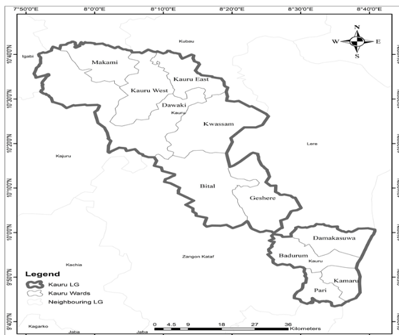
Map of the Kauru LGA and its Wards

Published

2026-11-02

How to Cite

Umar, H., Onimisi, M. Y., Viva, Y. I., Ige, O. O., Shuaibu, H. K., Yahaya, A., Hussain, M. A., & Humphrey, B. B. (2026). In Situ Gamma Dose Rates and Radiological Risk Indices at Artisanal Mining Sites in Kauru, Kaduna State, Nigeria. Nigerian Journal of Physics, 35(S), 543-553. https://doi.org/10.62292/njp.v35(s).2026.761