
Design and Simulation of a 2.5 GHz Rectangular Microstrip Patch Antenna

Authors

  • Raphael Adewalw Adenodi
    Department of Physics, Adeyemi Federal University of Education, Ondo

Keywords:

2.5 GHz, RMPA, FR4, Gain, Radiation Pattern

Abstract

Existing 2.5 GHz copper/FR4 Rectangular Microstrip Patch Antennas (RMPAs) achieve good impedance matching and wider bandwidth, but they do not simultaneously provide high gain, compact patch size, and precise resonance at 2.5 GHz, which the current simulation-based study seeks to address. This presents the design and simulation of a single-element RMPA operating at 2.5 GHz using the classical transmission-line model. The antenna comprises a copper patch of 38.2 mm by 25.5 mm on a 1.6 mm FR4 substrate, a copper ground plane of 45.88 mm by 57.2 mm, and a feed offset of 1.7 mm from the patch centre. The simulation resonates at 2.502 GHz, a deviation of only 2 MHz (0.08%) from the design target, with a return loss of 10.40 dB, a Voltage Standing Wave Ratio (VSWR) of 1.91:1, and a bandwidth of 60 MHz (2.40%), satisfying the conventional −10 dB and 2 VSWR acceptance criteria. The radiation pattern exhibits a boresight gain of 5.78 dBi, a front-to-back ratio of 15.88 dB, and a half-power beamwidth of about 80° with a mismatch efficiency of 90.24%. A clean main lobe with suppressed back and side radiation confirms RMPA suitability for directional point-to-point and point-to-multipoint links. Benchmarked against two reference designs, the proposed antenna achieves exceptional resonant-frequency accuracy, strong gain, directional radiation, and low-cost simple construction. Its weaknesses are weak impedance matching and narrow bandwidth.
Dimensions

Idris, M. N., Nasidi, I., & Musa, Z. (2023). Design and analysis of rectangular and circular microstrip patch antennas at 1.8 GHz for fixed point-to-point links applications. FUDMA Journal of Science, 7(3), 137–143. https://doi.org/10.33003/fjs-2023-0703-1764.

Abdi, I. A., Mohamed, A. H., Abdullahi, Z. Y., Ali, M. A., & Siyad, A. A. (2025). Design, simulation, and performance evaluation of a high-directivity microstrip patch antenna with a 2.5 GHz for modern wireless communication systems. SSRG International Journal of Electrical and Electronics Engineering, 12(2), 63–73. https://doi.org/10.14445/23488379/IJEEE-V12I2P108.

International Telecommunication Union. (2003). Sharing and adjacent band compatibility in the 2.5 GHz band between the terrestrial and satellite components of IMT-2000 (Report ITU-R M.2041).

Mishra, R., Kuchhal, P., & Kumar, A. (2015). Effect of height of the substrate and width of the patch on the performance characteristics of microstrip antenna. International Journal of Electrical and

Computer Engineering, 5(6), 1441–1445. https://doi.org/10.11591/ijece.v5i6.pp1441-1445.

Uqaili, R. S., Uqaili, J. A., Zahra, S., Soomro, F. B., & Akbar, A. (2020). A study on dual-band microstrip rectangular patch antenna for Wi-Fi. Proceedings of Engineering and Technology Innovation, 16, 1–12. https://doi.org/10.46604/peti.2020.6266.

Ramineni, P., & Nimmala, A. (2024). Design and analysis of microstrip patch antennas with polygonal and rectangular defected ground structures for sub-6GHz applications. International Journal

of Wireless and Microwave Technologies, 14(5), 44–58. https://doi.org/10.5815/ijwmt.2024.05.04.

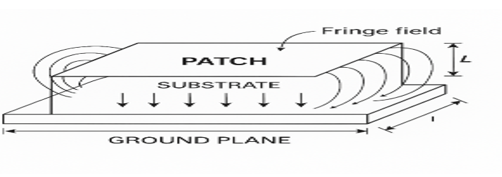
Fringe Field from Patch to Ground Plane

Published

2026-10-27

How to Cite

Adenodi, R. A. (2026). Design and Simulation of a 2.5 GHz Rectangular Microstrip Patch Antenna. Nigerian Journal of Physics, 35(S), 384-390. https://doi.org/10.62292/njp.v35(s).2026.739

How to Cite

Adenodi, R. A. (2026). Design and Simulation of a 2.5 GHz Rectangular Microstrip Patch Antenna. Nigerian Journal of Physics, 35(S), 384-390. https://doi.org/10.62292/njp.v35(s).2026.739