
Simulation-Based Evaluation of Temperature and PCB Thickness Effects on the Performance Efficiency of an RCC Smartphone Charger: ShPlus Model A1025 Charger as a Case Study

Authors

Keywords:

Smartphone charger, Temperature rise, Conversion efficiency, PCB thickness, RCC topology

Abstract

Smartphone chargers are switched-mode power supply (SMPS) devices that convert alternating current (AC) into regulated direct current (DC). During operation, heat generated by component losses affects electrical performance, efficiency, and reliability. Thermal behaviour is influenced by printed circuit board (PCB) physical properties. However, the influence of FR-4 PCB thickness on charger performance under varying temperatures has received limited attention. This study therefore investigated the effect of temperature rise on a smartphone charger for various FR-4 PCB thicknesses. A virtual simulation approach was used to investigate the SHPLUS model A1025 charger, modelled as a Ringing Choke Converter (RCC). Nine PCB thicknesses (0.80 mm to 4.00 mm) were considered. Input voltage was varied from 100 V to 240 V AC, while temperature was increased from 35°C to 100°C. An AI-assisted computation was employed to simulate conventional thermal equations and generated performance data for conversion losses and efficiency. Simulation showed that conversion losses increased with temperature, while conversion efficiency decreased correspondingly. Thicker PCBs exhibited slightly higher thermal-related losses. The study concludes that temperature rise adversely affects electrical performance by increasing conversion losses and reducing efficiency. Although PCB thickness influences thermal behaviour, its effect is less significant than operating temperature in RCC chargers. The study recommends adopting optimized PCB design parameters and thermal-management techniques to improve efficiency and stability.
Dimensions

Alade, M. O., and Adewole, S. A. (2026). AI-Enabled Investigation of the Effect of PCB Thickness on Conversion Losses and Efficiency of a DC-DC Buck Converter under Heatsink-Assisted Operation. Nigerian Journal of Physics, 35(1), 259–267. https://doi.org/10.62292/njp.v35i1.2026.504

Busatto, T., Rönnberg, S. K., and Bollen, M. H. J. (2022). Comparison of models of single-phase diode bridge rectifiers for their use in harmonic studies with many devices. Energies, 15(1). https://doi.org/10.3390/en15010066

de Jong, E. C. W., Ferreira, J. A., and Bauer, P. (2006). Design techniques for thermal management in switch-mode converters. IEEE Transactions on Industry Applications, 42(6), 1375–1386. https://doi.org/10.1109/TIA.2006.882674

Erickson, R. W. (1997). Fundamentals of Power Electronics. Springer US. https://doi.org/10.1007/978-1-4615-7646-4

Erickson, R.W. & Maksimović, D. (2020). Fundamentals of Power Electronics, 3rd ed. Springer. https://doi.org/10.1007/978-3-030-43881-4

Górecki, K., and Posobkiewicz, K. (2023). Influence of a PCB Layout Design on the Efficiency of Heat Dissipation and Mutual Thermal Couplings between Transistors. Electronics (Switzerland), 12 (19). https://doi.org/10.3390/electronics12194116

Halliday, D., Resnick, R., & Walker, J. (2013). Fundamentals of Physics (10th ed.). John Wiley & Sons.

Ikeri, H.I., Ohakwere-Eze, M.C., Asielue, O.K., Igbokwe, S.C., Nwobodo, A.N., Okongwu, O.K., Tasie, N. & Nwuke, E.E.O. (2024). Operating Principles, Design and Simulation of the Regulated AC to DC Converters. International Journal of Applied Electronics, 5(1), 6–21. https://iaeme-library.com/index.php/IJAE/article/view/IJAE_05_01_002

Jing, Z., Shuang, W. X., Jun, R. X., and Ya, Z. L. (2021). Design of a flyback high-efficiency switching power supply. Journal of Physics: Conference Series, 1748(5). https://doi.org/10.1088/1742-6596/1748/5/052042

Kazimierczuk, M. K., Lozito, G. M., Corti, F., and Reatti, A. (2023). Accurate design of output filter for DC–DC PWM buck converter and derived topologies. IEEE Transactions on Circuits and Systems I: Regular Papers. https://doi.org/10.1109/TCSI.2023.3238209

Letellier, A., Dubois, M. R., Trovão, J. P. F., & Maher, H. (2019). Calculation of Printed Circuit Board Power-Loop Stray Inductance in GaN or High di/dt Applications. IEEE Transactions on Power Electronics, 34(1), 612–623. https://doi.org/10.1109/TPEL.2018.2826920

Liu, H.-F., and Chang, L.-K. (2005). Flexible and low-cost design for a flyback AC/DC converter with harmonic current correction. IEEE Transactions on Power Electronics, 20(1), 17–24. https://doi.org/10.1109/TPEL.2004.839879

Malysheva, O., Vlasevskii, S., Barinov, I., Skorik, V., and Buniaeva, E. (2020). Regulated Single-Phase Rectifier Circuit Solutions and Their Impact on Power Coefficient. Advances in Intelligent Systems and Computing, 1115 AISC, 79–86. https://doi.org/10.1007/978-3-030-37916-2_9

Nguyen, M. H., & Blanchette, H. F. (2020). Optimizing AC Resistance of Solid PCB Winding. Electronics, 9(5), 875. https://doi.org/10.3390/electronics9050875

Papari, B., Ozkan, G., and Edrington, C. S. (2024). Emerging Trends and Challenges in Thermal Management of Power Electronic Converters: A State-of-the-Art Review. IEEE Access, 12, 50633–50672. https://doi.org/10.1109/ACCESS.2024.3385429

Rashid, M.H. (2014). Power Electronics: Devices, Circuits, and Applications, 4th ed. Pearson Education, pp. 71–78.

Sayed, K., Abozied, H., El-Zohri, E. H., and Sayed, R. (2015). Self-Oscillating Fly-back Converter for Mobile Batteries Charging Applications. IOSR Journal of Electrical and Ekectronics engineering 10(3), 70–78. https://doi.org/10.9790/1676-10327078

Sedra, A. S., Kenneth C., Tony C., and Smith, K. C. (2020). Microelectronic circuits (8th ed.). Oxford University Press.

Yahaya, Y., Ismail, G. S., and Buhari, M.A. (2021). Experimental Design and Implementation of AC – DC Handset Travel Charger. International Journal of Science for Global Sustainability, 6(4), 7. https://doi.org/10.57233/ijsgs.v6i4.61

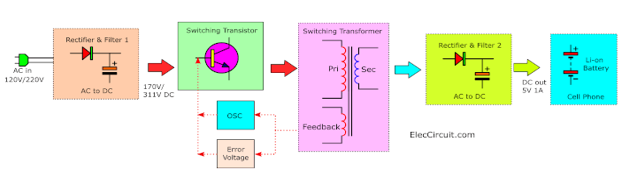
Block Diagram Illustrating the Major Power Conversion Stages in a Smartphone Charger

Published

2026-10-27

How to Cite

Alade, M. . O., & Isiaq, T. (2026). Simulation-Based Evaluation of Temperature and PCB Thickness Effects on the Performance Efficiency of an RCC Smartphone Charger: ShPlus Model A1025 Charger as a Case Study. Nigerian Journal of Physics, 35(S), 425-432. https://doi.org/10.62292/njp.v35(s).2026.729