
A Machine Learning–Based Adaptive Framework for Wind Energy Potential Assessment across Nigeria’s Climatic Zones

Authors

Keywords:

Machine Learning, Wind Energy Assessment, LSTM, Attention Mechanism, NiMet, Renewable Energy, Nigeria, GIS

Abstract

The current focus on transitioning of energy to cleaner and more sustainable energy systems has led to global increase in the search for effective methods to assess renewable energy potential. In this study, a machine learning-based adaptive framework is proposed for the assessment of wind energy potential across he different climatic zones in Nigeria. The framework proposed the modelling of a complex temporal and spatial dependencies in wind patterns by training a Long Short-Term Memory (LSTM) algorithm, enhanced with the attention-based mechanism on the Nigerian Meteorological Agency (NiMet) long-term data with attributes such as elevation, wind speed, wind direction, maximum temperature (Tmax), and minimum temperature (Tmin).  The proposed framework incorporates the comparism of the enhanced deep learning model with the baseline statistical approach (Weibull distribution), to evaluate the robustness of the proposed model. Additionally, the proposed framework is designed to integrate the output of the deep learning model into the Geographic Information System (GIS) for spatial analysis and wind farm site suitability mapping. The proposed framework in this study addresses some limitations in previous studies, including the utilization of conventional statistical models, and the focus on single locations. The expected result from the proposed framework is a higher accuracy and precision, with improved spatial adaptability when compared with the Weibull-based models, enabling more reliable wind energy assessment across Nigeria’s climatic zones. This study provides a data-driven approach that can be utilized for forecasting wind energy with higher accuracy and precision, aiding decision-makers in renewable energy planning and national grid optimization.
Dimensions

Abdulkadir, M. K. (2025). Wind speed distribution analysis and wind power density for Katsina, Nigeria. Journal of Energy Technology and Environment, 7(2). https://doi.org/10.5281/zenodo.15597806

Abdulkadir, M. K. (2025). Wind speed distribution analysis and wind power density for Katsina, Nigeria. Journal of Energy Technology and Environment, 7(2). https://doi.org/10.5281/zenodo.15597806

Akpaneno, A. F., & Bichi J. A. (2022). Nonlinear dynamical characterization of wind speed and wind power in Kano, Jigawa, and Katsina states of Nigeria. Nigerian Journal of Physics, 31(2), 215–223. https://njp.nipngr.org/index.php/njp/article/view/78

Akpootu D.O., Okpala, C.N., Iliyasu, M.I., Ohaji E.O., Idris, M., Abubakar M.B., Aina A.O., & Abdulsalami, M. (2022). Investigation of wind power potential in two selected locations in the Coastal Region of Nigeria. Science Forum (Journal of Pure And Applied Sciences) 22 (2022) 95 – 103. http://dx.doi.org/10.5455/sf.profdon03

Al-Selwi, S. M., Hassan, M. F., Abdulkadir, S. J., Muneer, A., Sumiea, E. H., Alqushaibi, A., & Ragab, M. G. (2024). RNN-LSTM: From applications to modeling techniques and beyond — Systematic review. Journal of King Saud University – Computer and Information Sciences, 36(5), Article 102068. https://doi.org/10.1016/j.jksuci.2024.102068

Audu, M. O., Terwase, A. S., & Isikwue, B. C. (2019). Investigation of wind speed characteristics and its energy potential in Makurdi, north-central, Nigeria. SN Applied Sciences, 1, 178. https://doi.org/10.1007/s42452-019-0189-x

Audu, M. O., Terwase, A. S., & Isikwue, B. C. (2019). Investigation of wind speed characteristics and its energy potential in Makurdi, north-central, Nigeria. SN Applied Sciences, 1, 178. https://doi.org/10.1007/s42452-019-0189-x

Belletreche, M., Bailek, N., Abotaleb, M., Bouchouicha, K., Zerouali, B., Guermoui, M., Kuriqi, A., Alharbi, A. H., Khafaga, D. S., El-Shimy, M., & El-Kenawy, E. M. (2024). Hybrid attention-based deep neural networks for short-term wind power forecasting using meteorological data in desert regions. Scientific Reports, 14(1), 21842. https://doi.org/10.1038/s41598-024-73076-6

Belletreche, M., Bailek, N., Abotaleb, M., Bouchouicha, K., Zerouali, B., Guermoui, M., Kuriqi, A., Alharbi, A. H., Khafaga, D. S., El-Shimy, M., & El-Kenawy, E. M. (2024). Hybrid attention-based deep neural networks for short-term wind power forecasting using meteorological data in desert regions. Scientific Reports, 14(1), 21842. https://doi.org/10.1038/s41598-024-73076-6

Jia, H., Sun, H., & Bai, S. (2025). Decomposition LSTM with dual multi-head self-attention for wind turbine drivetrain state forecasting. Turkish Journal of Electrical Engineering and Computer Sciences, 33(2), Article 4. https://doi.org/10.55730/1300-0632.4118

Khan, W., Daud, A., Khan, K., Muhammad, S., & Haq, R. (2023). Exploring the frontiers of deep learning and natural language processing: A comprehensive overview of key challenges and emerging trends. Natural Language Processing Journal, 4, Article 100026. https://doi.org/10.1016/j.nlp.2023.100026

Mei, J., Wang, C., Luo, S., Xu, W., & Deng, Z. (2024). Short-term wind power prediction based on encoder–decoder network and multi-point focused linear attention mechanism. Sensors, 24(17), 5501. https://doi.org/10.3390/s24175501

Mei, J., Wang, C., Luo, S., Xu, W., & Deng, Z. (2024). Short-term wind power prediction based on encoder–decoder network and multi-point focused linear attention mechanism. Sensors, 24(17), 5501. https://doi.org/10.3390/s24175501

Moshtaghi, P., Hajialigol, N., & Rafiei, B. (2025). A comprehensive review of artificial intelligence applications in wind energy power generation. Sustainable Futures, 9, Article 100638. https://doi.org/10.1016/j.sftr.2025.100638

Nkalo, U. K. (2025). Nigeria’s renewable energy sector: Analysis of the present and future prospects. Solar Compass, 14, Article 100123. https://doi.org/10.1016/j.solcom.2025.100123

Nymphas, E. F., & Teliat, R. O. (2024). Evaluation of the performance of five distribution functions for estimating Weibull parameters for wind energy potential in Nigeria. Scientific African, 23, e02037. https://doi.org/10.1016/j.sciaf.2023.e02037

Ogunsola, O. & Osagiede, O. (2018). Wind Speed Analysis at Ikeja, Nigeria Using The Conventional Probability Density Functions. Journal of Engineering Studies and Research – Volume 24 (2018) No. 3

Summerfield-Ryan, O., & Park, S. (2023). The power of wind: The global wind energy industry’s successes and failures. Ecological Economics, 210, Article 107841. https://doi.org/10.1016/j.ecolecon.2023.107841

Tuncar, E. A., Sağlam, Ş., & Oral, B. (2024). A review of short-term wind power generation forecasting methods in recent technological trends. Energy Reports, 12, 197–209. https://doi.org/10.1016/j.egyr.2024.06.006

Ukoba, M. O., Diemuodeke, O. E., Alghassab, M., Njoku, H. I., Imran, M., & Khan, Z. A. (2020). Composite multi-criteria decision analysis for optimization of hybrid renewable energy systems for geopolitical zones in Nigeria. Sustainability (Switzerland), 12(14). https://doi.org/10.3390/su12145732

Yassen, M. A., El-Kenawy, E. M., Abdel-Fattah, M. G., Ismail, I., & Mostafa, H. E. S. (2025). Explainable artificial intelligence for wind power forecasting model based on long short-term memory. Neural Computing and Applications, 37, 14589–14611. https://doi.org/10.1007/s00521-025-11230-5

Zehtabiyan-Rezaie, N., Iosifidis, A., & Abkar, M. (2023). Physics-guided machine learning for wind-farm power prediction: Toward interpretability and generalizability. PRX Energy, 2(1), 013009. https://doi.org/10.1103/PRXEnergy.2.013009

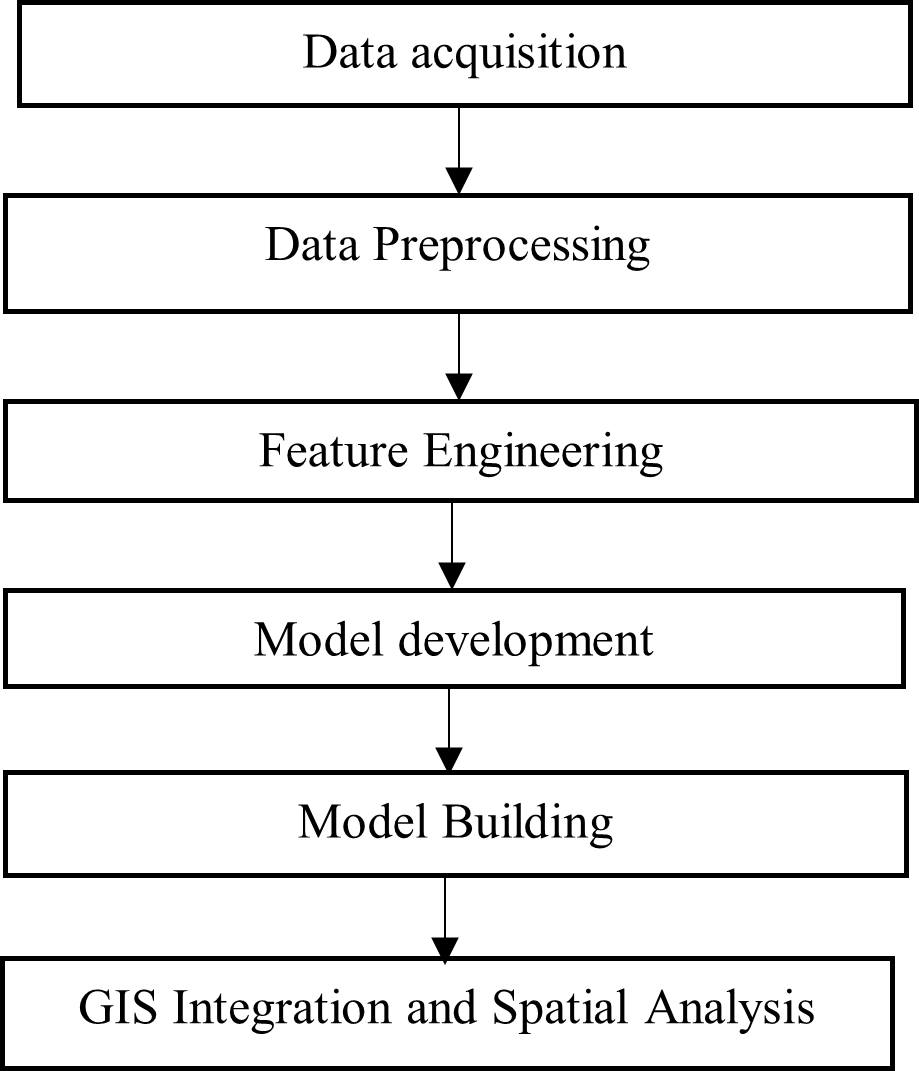
Proposed methodological workflow

Published

2025-12-10

How to Cite

Okpala, C. N., Tijjani, B. I., & Yohanna, A. (2025). A Machine Learning–Based Adaptive Framework for Wind Energy Potential Assessment across Nigeria’s Climatic Zones. Nigerian Journal of Physics, 35(1), 1-7. https://doi.org/10.62292/10.62292/njp.v35i1.2026.474

How to Cite

Okpala, C. N., Tijjani, B. I., & Yohanna, A. (2025). A Machine Learning–Based Adaptive Framework for Wind Energy Potential Assessment across Nigeria’s Climatic Zones. Nigerian Journal of Physics, 35(1), 1-7. https://doi.org/10.62292/10.62292/njp.v35i1.2026.474