
Determination of Power Density from Radiofrequency Exposure by Base Transceiver Stations and Implications for Ado-Ekiti Residents

Authors

  • Ojo Emmanuel Oludare
    Bamidele Olumilua University of Education, Science and Technology, Bamidele Olumilua University of Education, Science and Technology, Ikere-Ekiti image/svg+xml
  • Oyebamiji Oyedele Oketayo
    Federal University Oye Ekiti image/svg+xml
  • Wilfred N. Igboama
    Federal University Oye Ekiti image/svg+xml
  • Funmilayo Hannah Abejide
    Joseph Ayo Babalola University image/svg+xml
  • Oyewole David Ajadi
    Ora Community High School, Ora Ekiti
  • Tolulope Ebunoluwa Karokatose
    University of Ilesa image/svg+xml
  • Ayodele Philip Olufemi
    University of Medical Sciences, Ondo image/svg+xml

Keywords:

Non-ionizing radiation, Health effect, Human body surface area, Body temperature

Abstract

The non-ionizing (RF) energy from base transceiver stations (BTS) is radiated into space through its antennas. The Human Body Surface Area (HBSA) can significantly influence the coupling of electromagnetic fields with the body, thereby resulting to energy absorption, increase in body temperature and possibly affect some physiological parameters. The health implications of RF exposure from telecommunication mast are becoming important as base stations get increasingly installed. In this study, the power density (PD) was measured using Pro Triple Axis RF/High Frequency Meter (HF-B8G) at distance (10 – 110 m) in thirty (30) active base transceiver stations (BTS) in Ado-Ekiti. Parameters of health importance such as blood pressure (BP), body temperature and body mass index (BMI) of 300 subjects around the base stations were monitored for 30 days using calibrated instruments. These measurements were recorded at a minimum of six symmetric locations around each individual BTS, with the coordinates of each location noted using portable Global Positioning System (GPS) device. The correlations among PD, HBSA and physiological parameters of nutritional/health importance were done using SPSS Vs 18 at 0.01 and 0.05 levels of significance. The results indicated that PD ranged from 0.32 to 96.89 mW/m2 while the average radiation received by HBSA ranged from 19.62 to 40.95 mWm-2. For the three classes of subjects (adult male, adult female and children), the power density in the observed active 30 base stations were below ICNIRP recommended limits (4.7 W/m2). At 0.05 level of significance, PD correlated positively with diastolic blood pressure (DBP, r = 0.695), HBSA (r = 0.661- 0.904) and at 0.01 level, BMI also correlated with Age, HBSA and PD (r = 0.688 – 0.948). This suggested the possibility of the influence of these physiological parameters by exposure to RF which could cause potential health risk to the residents.
Author Biographies

Ojo Emmanuel Oludare

Department of Physics

Oyebamiji Oyedele Oketayo

Department of Physics, Professor

Wilfred N. Igboama

Department of Physics

Funmilayo Hannah Abejide

Department of Physics

Oyewole David Ajadi

Science Teacher

Tolulope Ebunoluwa Karokatose

Department of Physics with Electronics 

Ayodele Philip Olufemi

Department of Physics

Dimensions

Achudume, A., Onibere, B., Aina, F. & Tchokossa, P. (2010). Induction of Oxidative Stress in Male Rats Sub-Chronically Exposed to Electromagnetic Fields at Non-Thermal Intensities. Journal of Electromagnetic Analysis & Application. Vol.2: 507-512.

Akinola Oyedele (2019) Use of remote sensing and GIS techniques for groundwater exploration in the basement complex terrain of Ado‑Ekiti, SW Nigeria. journal of Applied Water Science (2019) 9:51 https://doi.org/10.1007/s13201-019-0917-9.

Akinyemi, L. A., Makanjuola, N. T., Shoewu, E. D. O. O., & Edeko, F. O. (2014). Comparative Analysis of Base Transceiver Station (BTS) and Power Transmission Lines Effects on the human body in lagos Environs. African Journal of Computing & ICT vol. 7 (2) ISSN 2006-1781 pp 33-44 https://www.researchgate.net/publication/326493973

Akinyemi, L. A., Makanjuola, N. T., Shoewu, E. D. O. O., & Edeko, F. O. (2014). Comparative Analysis of Base Transceiver Station (BTS) and Power Transmission Lines Effects on the human body in lagos Environs. African Journal of Computing & ICT vol. 7 (2) ISSN 2006-1781 pp 33-44 https://www.researchgate.net/publication/326493973

American Cancer Society ACS (2019). Cancer Prevention & Early Detection Facts & Figures 2019-2020. Atlanta: American Cancer Society; 2019

Bello, A., Onyoku, G. O., Usman, R., Otto, & Abdullahi, A. H. (2023). Radiated Power From Mobile Base Stations (Mbs) and the Level of Awarenes of Residents Living Close to It. Journal Research Square (Research Square). https://doi.org/10.21203/rs.3.rs-2702208/v1

Bevelaqua & Peter J. (2015). Types Of Antennas‖ (http://www.antenna- theory.com/antennas/main.php). Antenna-Theory.Com. journal of the royal society interface. 17(1):31-43 Retrieved August 8, 2015.

Eltiti S., Wallace D., R. dgewell, Zougkou K., Russo R., Sepulveda F., Mirshekar‐Syahkal D., Rasor P., Deeble R., & Fox E. (2016). Does short-term exposure to mobile phone base station signals increase symptoms in individuals who report sensitivity to electromagnetic fields? A double blind provocation study. Electromagnetic fields. Journal of lancet oncology, vol.12(7):624-626. Retrievd July 13, 2016 from http://tinyurl.com/39ddyv.

Girish Kumar (2010). Advantages and Disadvantages of Cell Phone Technology. Report on Cell Tower Radiation. Report sent to Department of Telecommunications, Delhi, India.

Godfrey E. Ekata (2015). A Model for assessing base Stations for Compliance with Safety Limits for Human Exposure to Electromagnetic Fields (EMFs) in Nigeria. International Journal of Engineering Research & Technology.4 (6): 791-798

ICNIRP (2020). Guidelines for Limiting Exposure to Electromagnetic Fields (100 kHz to 300 GHz). Health Physics, 118(5):483–524.

International Commission on Non-Ionizing Radiation Protection (ICNIRP). Exposure to high frequency electromagnetic fields, biological effects and health consequences (100 kHz-300 GHz). Munich, Germany, 2019. ISBN 9783934994102.

Ilesanmi B. O, Adedeji M. Faluru, Tayo D. & Obasanyo (2021) Radio frequency peak and average power density from mobile base stations in Ekiti State, Nigeria Bulletin of Electrical Engineering and Informatics Vol. 10, No. 1, February 2021, pp. 224~231 ISSN: 2302-9285, https://doi.org/10.11591/eei.v10i1.1879.

Islaim M. R., Khalifa, O. O., Ali, L., Azli, A., & Zulkarnain, M. (2020). Radiation measurement from mobile base stations at a university campus in Malaysia. American Journal of Applied Sciences, 3(4): 1781-1784

Jauchem J.R. (2008). Effects of low-level radio frequency (3 kHz to 300GHz) energy on human cardiovascular, reproductive, immune and other system: a review of recent literature. International Journal of Hygiene and environmental health. 1-29.

Nazerian A, Jafarzadeh A, Salehi S, Ghasemi M, & Goodarzi A. (2025) Cyclosporin for the treatment of Stevens-Johnson syndrome (SJS) and toxic epidermal necrolysis (TEN): a systematic review of observational studies and clinical trials focusing on single therapy, combination therapy, and comparative assessments. Inflammopharmacology, 33(2):485-503.

Olawale K. O., Ajayi, O. S., & Ojo, J. S. (2021). Diurnal variation of RF power density with distance from selected mobile phone base transceiver stations in Offa metropolis, Kwara State Nigeria. Journal of Physics, 2034(1), 012009.

Looney, D.P., Potter, A.W., Arcidiacono, D.M., santee, W.R., & Friedl, K.E (2023). Body Surface area equations for physically active men and women. American Journal of human biology 35(2) e23823 https://doi.org/10.1002/ajhb.23823.

Redlarski, G., Koziel. S, Krawczuk, M., Siebert,J., Talalaj, M., Palkowski, L.S. (2024. An improvement of body surface area formula using the 3d scanning technique. International journal of occupation medicine and environmental Health. 37(2), 205-219. https://doi.org/10.13075/ijomeh.1896.02356

Samaila, B., Ah, A., Mn, Y., & Abubakar, N. (2023). Residential exposure to non-ionizing electromagnetic radiation from mobile base stations: a systematic review on biological effects assessment. Material Science & Engineering International Journal, 7 (2), 44–52. https://doi.org/10.15406/mseij.2023.07.00203

Teerapot W. and Phodungsak R. (2018) Temperature Induced in Human Organs due to Near-Field and Far-Field Electromagnetic Effects, Int. J. Heat & Mass Transport, 119, 65 -78.

World Cancer Research Fund/American Institute for Cancer Research WCS/AICR (2020). Diet, Nutrition, Physical Activity, and Cancer: A Global Perspective. Continuous Update Project Expert Report 2018. Accessed at https://www.wcrf.org/dietandcancer on June 3, 2020.

World Health Organization (2007). Extremely Low Frequency Fields, Environmental Health Criteria 238. Geneva, Switzerland, ISBN 9789241572385.

Zhou Y, Chen W, Fang L, Qiu F, Wu J, Li J. (2024) Effectiveness, quality of life, and safety of secukinumab versus conventional systemic therapy in patients with erythrodermic psoriasis: a comparative study. Front Med (Lausanne), 11:1473356. [PMC free article: PMC11602294] [PubMed: 39610686].

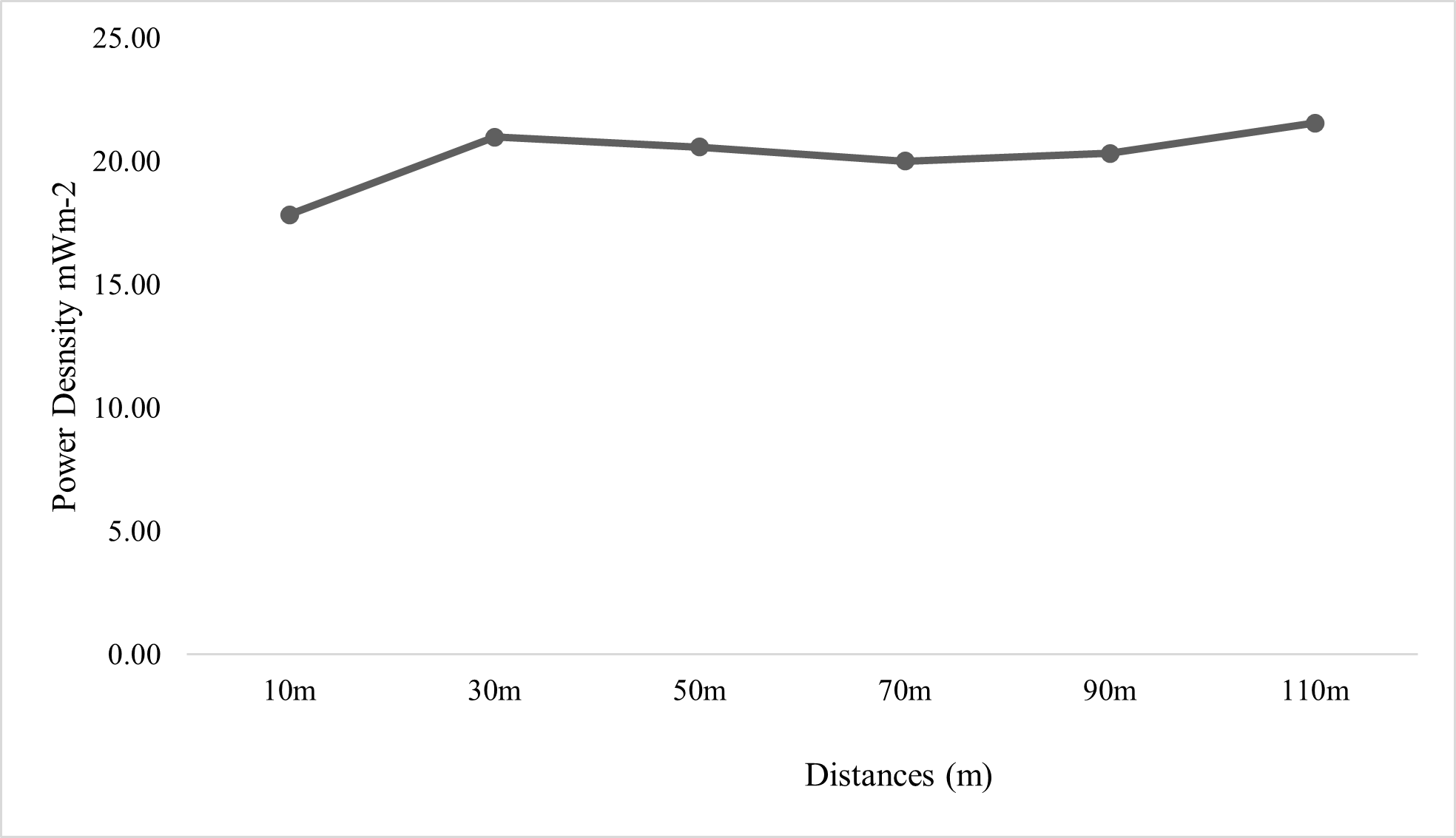
Average power density with respect to distances from the source

Published

2025-12-09

How to Cite

Oludare, O. E., Oketayo, O. O., Igboama, W. N., Abejide, F. H., Ajadi, O. D., Karokatose, T. E., & Olufemi, A. P. (2025). Determination of Power Density from Radiofrequency Exposure by Base Transceiver Stations and Implications for Ado-Ekiti Residents. Nigerian Journal of Physics, 34(4), 168-176. https://doi.org/10.62292/10.62292/njp.v34i4.2025.446

How to Cite

Oludare, O. E., Oketayo, O. O., Igboama, W. N., Abejide, F. H., Ajadi, O. D., Karokatose, T. E., & Olufemi, A. P. (2025). Determination of Power Density from Radiofrequency Exposure by Base Transceiver Stations and Implications for Ado-Ekiti Residents. Nigerian Journal of Physics, 34(4), 168-176. https://doi.org/10.62292/10.62292/njp.v34i4.2025.446